
Crypto Stock: Circle Wants To Be a Bank, What’s Implication For CRCL?

American stablecoin and payments firm Circle Internet Financial has confirmed it had applied to the U.S. Office of the Comptroller of the Currency (OCC).
The company is seeking a national trust bank charter that would allow it to launch First National Digital Currency Bank, N.A.
The charter would give Circle the authority to manage its stablecoin reserves, without offering deposit or loan services.
Circle’s Charter Application Explained
According to reports, Circle, the issuer of USDC, aims to establish a regulated trust bank.
The bank’s goal will be to manage its reserve assets and fiduciary operations. The plan was disclosed in an official press release late Monday.
Notably, an approval from the OCC would make Circle only the second crypto firm to hold this type of license.
They will become another crypto company to do so after Anchorage Digital.
The proposed trust bank would not function like a traditional bank. It would not accept cash deposits or issue credit.
Instead, it would focus solely on reserve custody and fiduciary services tied to Circle’s stablecoin operations.
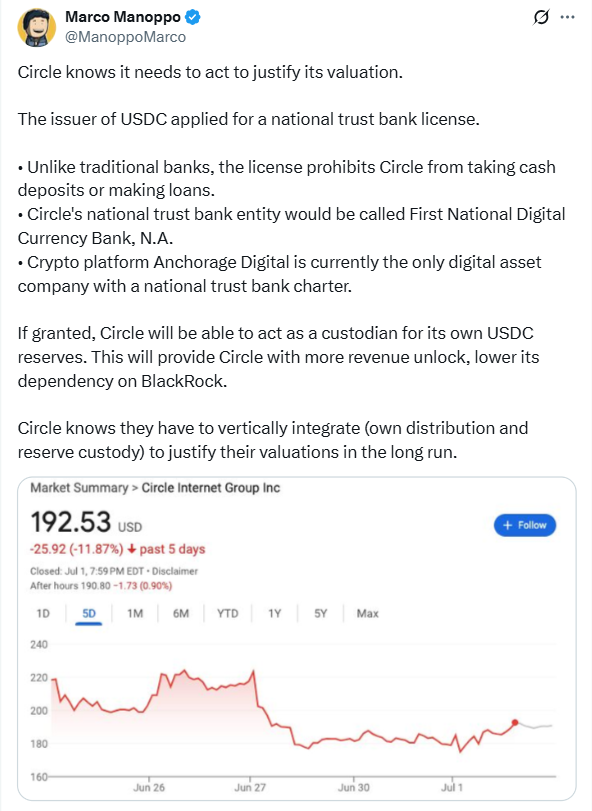
Meanwhile, Circle’s stock, CRCL, closed at $192.53 on July 1, up 6.20% for the day.
However, it later slipped 2.20% to $188.62 in early pre-market trading.
Still, the company currently has a market capitalization of $46.694 billion, ranking it among the top publicly traded cryptocurrency firms.
The firm’s stock has risen sharply since its IPO on June 5, 2025, where it debuted at $31.
How the Move May Affect Circle Stock
Securing a trust bank license could give Circle tighter control over its core financial operations.
Currently, Circle’s reserves are stored at the Bank of New York Mellon and managed by asset management giant BlackRock.
If granted the license, Circle would manage these reserves internally. This could improve operational efficiency and regulatory alignment.
Also, this step may help Circle meet conditions set out in the upcoming U.S. stablecoin legislation.
As reported, a proposed law, known as the GENIUS Act, is expected to introduce stricter rules governing the handling of reserves.
It will require federal oversight for larger stablecoin issuers. Circle’s move positions it ahead of those changes.
Interestingly, we covered recently that the United States Senate on June 17 passed the GENIUS Act with a 68–30 vote.
Similarly, Circle stock performance could be influenced by how investors view the potential regulatory approval.
While the crypto stock dipped slightly the following morning, it remained up more than 470% from its IPO price.
Stablecoins Draw Bigger Interest as Legislation Nears
Circle’s application highlights the growing importance of the $253 billion stablecoin market.
For context, top financial institutions have been adjusting their digital currency strategies. These include JPMorgan Chase, Bank of America, Visa, and Mastercard.
Their shift comes as U.S. lawmakers move closer to passing regulations focused on stablecoins.
Treasury Secretary Scott Bessent recently projected that stablecoin legislation could help grow the U.S. market to over $2 trillion by 2028.
Analysts at Bernstein have also forecasted global market growth reaching $4 trillion over the next decade.
With its second-largest stablecoin, USDC, Circle is positioned to benefit from these changes.
This, however, is pending the approval of its bank charter and broader adoption of digital financial infrastructure.
It is worth noting that on July 1, Stablecoins reached a market capitalization of over $260 billion.
The post Crypto Stock: Circle Wants To Be a Bank, What’s Implication For CRCL? appeared first on The Coin Republic.