
RedStone Launches ‘First Oracle with Native Liquidation Intelligence’

Major oracle network RedStone, has launched its Atom oracle, which allows real-time liquidations and automated native MEV (Miner Extractable Value) capture for DeFi lending protocols.
According to the press release shared with Cryptonews, RedStone Atom is “the first oracle with native liquidation intelligence.”
LENDING SUPERCHARGED. RedStone Atom is live.
— RedStone
The first oracle with liquidation intelligence, designed for the needs of lending protocols.
Zero-latency liquidations. Native OEV capture. No-code integration.
Increased security AND yield for lending markets. Only on @unichainpic.twitter.com/iSfpEoElL4
(@redstone_defi) July 29, 2025
Validators or block builders typically compete to liquidate users during oracle lags, that way getting MEV. Notably, liquidation MEV has cost DeFi protocols more than $500 million, says the announcement.
Therefore, Atom captures “value at the source, inside the oracle layer itself.” It then sends the recaptured MEV directly to the protocol, which can then use it to lower interest rates/fees, improve yield, or further sustainability and incentives.
The new product enables Oracle Extractable Value (OEV) capture, zero-latency liquidations, and immediate onchain price updates. This, the team says, improves lending efficiency and does not require changes to existing protocol code.
Additionally, embedding MEV capture directly into the oracle layer, improves performance, capital efficiency, and sustainability, it claims.
Moreover, Atom is now securing all lending protocols on Unichain, and it’s ready to use on BNB Chain, Base, HyperEVM, and Berachain.
Meanwhile, Atlas, an application-specific sequencer by FastLane Labs, powers Atom. This enables atomic MEV auctions, says the press release. It explains that “an ultra-fast auction (
Among the competing bidders, one will have the right to execute the liquidation. The bid is settled onchain with the price update. “It works across all EVM chains, requires no offchain components or centralized actors, and can be activated instantly,” RedStone says.
RedStone: ‘Whoever Liquidates First Wins’
The press release highlights the drawbacks of the traditional “push” oracles in DeFi lending. These update prices at certain intervals/events, which causes delays during market volatility.
And given that “whoever liquidates first wins,” this situation leads to missed liquidation windows and lost revenue, RedStone argues.
Therefore, Atom allows liquidators to trigger a real-time price update at the very moment they see a liquidation opportunity. The team noted several key benefits of this, primarily capturing “more liquidation opportunities faster than competitors.”
Others include better risk-adjusted returns to users, higher loan-to-value (LTV) ratios, and holding MEV “that would otherwise leak to third parties.”
7/ Let that sink in: RedStone Atom demands *zero* integration effort.
— RedStone (@redstone_defi) July 29, 2025
Protocols keep their existing feed interface. No proxy feeds. No rewrites.
Simply request Atom on your RedStone feed, and let us coordinate the setup.
“Onchain lending is entering a new phase of competition, and protocols need innovative, yet reliable, infrastructure to stay ahead,” said co-founder Marcin Kaźmierczak.
He continues: “Atom flips the liquidation model on its head. Instead of third parties profiting from user liquidations, protocols can now decide how that value is shared, whether through incentives, yield boosts, or borrower rewards.”
Meanwhile, RedStone is a blockchain oracle provider delivering cross-chain data feeds to power DeFi protocols on Ethereum, Avalanche, and Polygon.
In March 2025, RedStone launched its native token RED on Ethereum.
RED all-time price chart:
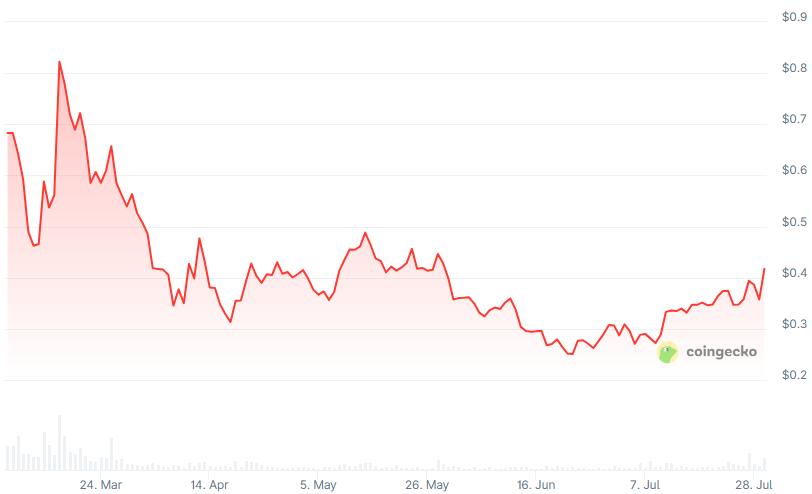
Over the past 24 hours, the coin appreciated by 8.8% to the price of $0.4183.
It’s also up 14.4% in a week and 45% in a month.
It hit its all-time high of $0.9325 upon the launch, on 6 March, dropping 55% since.