
Asia Morning Briefing: Vitalik's Plan Can Bring ETH to $3,000 and Crypto 'More Popular' Than Stocks in Korea

Good Morning, Asia. Here's what's making news in the markets:
Welcome to Asia Morning Briefing, a daily summary of top stories during U.S. hours and an overview of market moves and analysis. For a detailed overview of U.S. markets, see CoinDesk's Crypto Daybook Americas.
Macro Events and Vitalik's Bold Plan to 10x Ethereum Layer 1 Could Propel ETH Past $3000: OKX's Lennex Lai
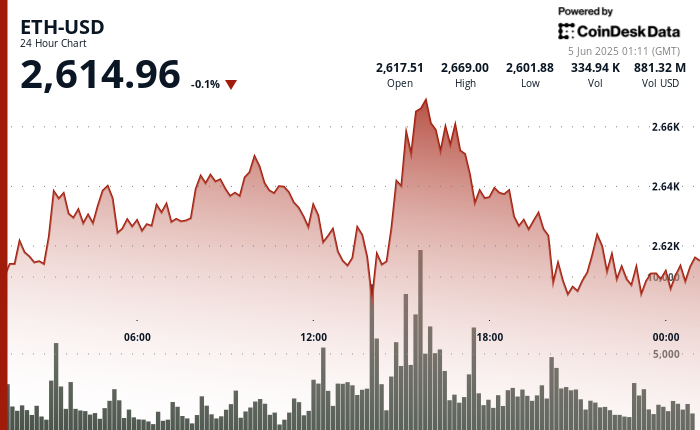
ETH traders are eying $2600 as Asia begins its business day, but OKX's Chief Commercial Officer Lennex Lai sees an easy path for the token to hit $3000 if Vitalik Buterin can get rid of Ethereum's reliance on Layer-2s.
Layer 1 refers to the main blockchain infrastructure, such as Ethereum itself, while Layer 2 solutions are secondary systems built on top of Layer 1 to enhance scalability and speed up transactions.
"Vitalik’s pivot to scale Ethereum Layer 1 by 10x will be a game-changer, shifting focus away from heavy reliance on Layer 2 solutions like sharding," Lai said in a note to CoinDesk, referring to recent comments Buterin made at ETHGlobal Prauge.
"On our platform, ETH perpetual futures made up 44.2% of trading volume over the past 7 days, showing us that sophisticated investors are closely tracking this evolution," he continued.
Lai points to this week's key macro events, like the ECB's rate decision and U.S. jobs data, as factors that could significantly impact risk-on appetite, potentially pushing ETH past $3,000 short-term, though Ethereum’s long-term success hinges on Vitalik's ambitious roadmap.
Elsewhere, CoinDesk Research's technical analysis model bot highlights Ethereum's resilience above critical support at $2,600, driven by institutional inflows nearing $1.2 billion and significant whale buying, positioning ETH for a possible altcoin rally.
Hashed CEO Simon Kim Says Korea Election Boosts Crypto, Stablecoins, and AI
Simon Kim, the CEO of Korea's largest crypto fund Hashed, believes crypto has become a critical force in South Korean politics, and it's going to be business as usual for the industry under the country's new left-leaning President Lee Jae-myung.
"Officially, crypto is more popular than the stock market in Korea," Kim said in a recent interview with CoinDesk.
He pointed to data showing 16.29 million daily active crypto traders compared to 14.24 million active equity traders, noting that political parties now see supporting crypto as essential to winning elections.
South Korea’s crypto policies also continue to be closely tied to U.S. regulatory developments, according to Kim.
"All the Korean politicians are following the U.S.," he explained, noting how American institutions and regulators are guiding global standards. Kim added that Korea’s previously set crypto capital gains tax policy, scheduled to begin in early 2027, remains unchanged.
Kim expects Lee's administration to develop stablecoin policy, as they currently account for about one-tenth of Korea’s crypto trading volume.
Issuing a stablecoin in Korea might be complicated because the Korean won is a tightly controlled onshore currency with strict capital restrictions, making it challenging to integrate into borderless crypto markets.
Kim said that in his conversations with some policymakers, they say there is "no kind of benefit to adopting stablecoin won in the Korean market," given its advanced payments ecosystem.
But stablecoins are here to stay, as Kim says they already account for one-tenth of trading volume in the country, and there's a growing recognition that they need to be safely integrated into the economy, where they can be taxed.
"Stablecoins are not just a payment network," he said. "It's building a unique digital platform enabling smart contracts and making an autonomous economy."
Beyond crypto, Kim expects Lee’s administration to pursue substantial investment in artificial intelligence.
Yet Kim expressed skepticism about plans to create a sovereign generalized AI platform comparable to U.S. giants like OpenAI.
Instead, he argued Korea’s strength is in "physical AI", building specialized solutions tailored to sectors where Korea excels, including semiconductors, electronics, and advanced manufacturing.
“I believe the new administration has some sense that we have unfair advantages in the physical AI ecosystem. That's the point I'm very excited about,” he said.
News Roundup
Circle Prices IPO at $31 Per Share
Circle priced its IPO at $31 per share, surpassing the anticipated range of $24 to $26, raising approximately $1.1 billion and valuing the stablecoin issuer at around $6.9 billion, CoinDesk previously reported. The offering included about 34 million shares, significantly more than the initially planned 24 million, indicating strong market demand.
Trading under the ticker "CRCL," Circle will debut Thursday on the New York Stock Exchange, marking a major milestone after a previous failed SPAC attempt in 2021. As issuer of the USDC stablecoin, Circle's listing arrives amid renewed legislative interest in digital assets and potential regulatory clarity, potentially strengthening investor confidence amid recent crypto volatility.
Trump's Crypto Connections Under Scrutiny as US Congress Debates Crypto Regulation Bill
U.S. House Republicans are advancing legislation to regulate crypto markets through the Digital Asset Market Clarity Act, CoinDesk previously reported, holding two hearings Wednesday in preparation for a potential committee markup next week.
Republicans argue the bill urgently addresses the crypto industry's demand for clear regulatory frameworks to prevent innovations from moving offshore, highlighting the risk of the U.S. falling behind Europe and Asia in crypto oversight.
Democrats, however, criticize the legislation as rushed, complex, and lacking sufficient consumer protection, particularly citing unresolved conflict-of-interest concerns related to President Donald Trump's personal cryptocurrency business activities. Democrats insist the bill needs stringent safeguards and transparency measures, as Representative Jim Himes emphasized, to secure bipartisan support, while Republicans largely dismiss these allegations as politically motivated distractions.
Market Movements:
- BTC: Bitcoin saw notable volatility, swinging 1.67% amid significant institutional withdrawals, struggling to hold support above $105,000 as trade disputes heightened market uncertainty.
- ETH: Ethereum surged 4%, rebounding from a strong support near $2,590 driven by institutional buying and whale accumulation, forming a potential base for an upward breakout.
- Gold: Gold rallied over 0.80% to $3,382, recovering from a $3,343 low after weaker U.S. economic data and escalating US-China trade tensions boosted safe-haven demand
- Nikkei 225: Japan's Nikkei 225 dipped 0.39% at the open amid mixed Asia-Pacific trading, driven by concerns over a cooling U.S. job market
- S&P 500: The S&P 500 closed modestly higher at 5,970.81 Wednesday, supported by tech shares despite concerns over weak hiring data and escalating trade tensions.
Elsewhere in Crypto:
- Trump’s CFTC pick Brian Quintenz set for Senate hearing on June 10 (The Block)
- Ethereum Foundation expects 2025-26 to be ‘pivotal’ for the ecosystem as it reforms its treasury management (The Block)
- Vitalik Buterin Uses Privacy Tool Railgun Again, Signaling Ongoing Embrace of On-Chain Anonymity (CoinDesk)