
Bitcoin Decentralization Under Pressure: Is Cardano Better Positioned?

Bitcoin has always been praised for being decentralized. But now, that core idea of Bitcoin decentralization is being questioned; not by skeptics, but by data.
Mining power is concentrating, security assumptions are getting tested, and a quiet debate is starting: Is Bitcoin becoming too centralized?
Surprisingly, Cardano is coming out ahead in some of these metrics. The charts paint a clear contrast. Let’s look at the numbers, the risks, and why decentralization might not mean what it used to.
Bitcoin Decentralization at Risk
Over the past few months, just three mining pools — Foundry USA, AntPool, and ViaBTC — have come to control 62.33% of Bitcoin’s entire network hashrate.
That means more than half of the Bitcoin network is managed by three organizations.
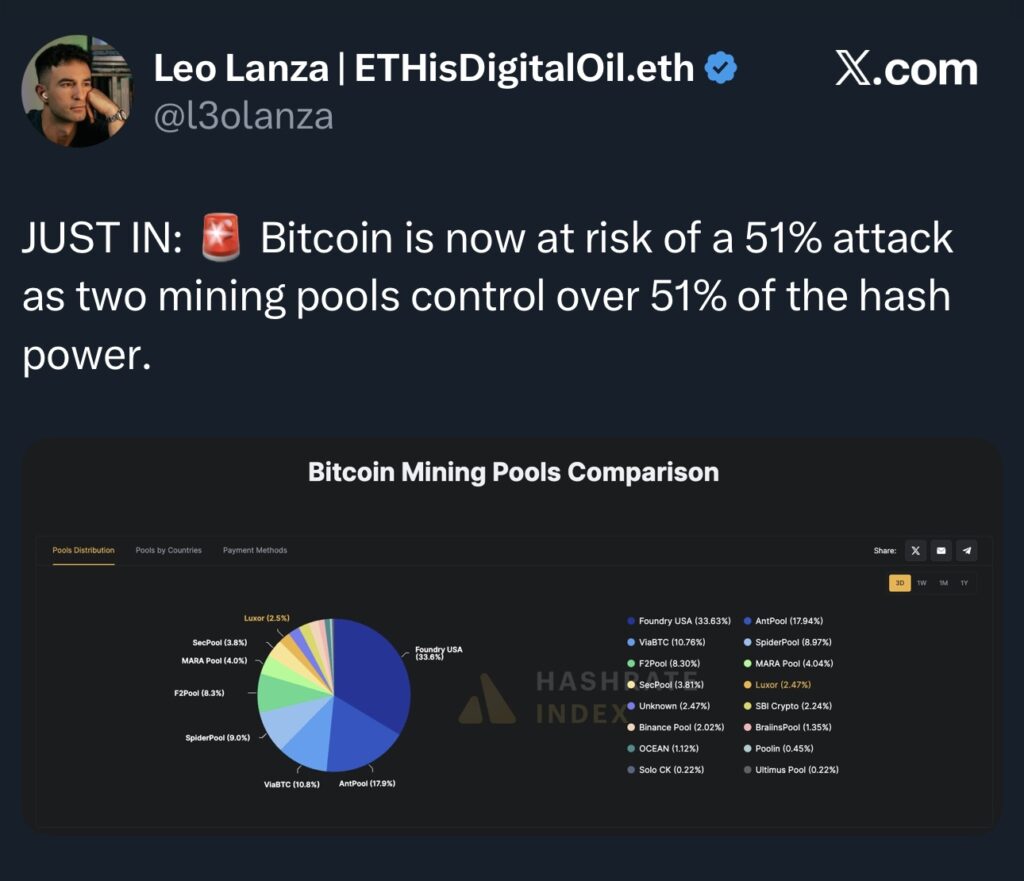
Here’s how the split looked:
- Foundry USA: 33.63%
- AntPool: 14.85%
- ViaBTC: 13.85%
- Others like F2Pool, Luxor, MaraPool, and Binance Pool each had under 5%
- Legacy players like Slush Pool and SBI Crypto are now nearly invisible on the charts
Foundry USA, in particular, has surged in share. Back in 2022, it was already a major miner, but its current dominance is the highest ever recorded. It’s also U.S.-based, which introduces jurisdictional concentration.
If U.S. regulators take action or if Foundry faces operational disruption, a big chunk of Bitcoin mining would be affected.
Even among the remaining pools, many are linked by infrastructure, hardware contracts, or shared locations. That means the effective decentralization is likely even lower than it looks on paper.
Cardano’s 1,400+ Stake Pools Make It More Distributed
Meanwhile, Cardano (ADA) is showing a very different picture. It currently operates with over 1,400 active stake pools.
No single entity holds more than 5% control, and the protocol design prevents dominance by large operators.
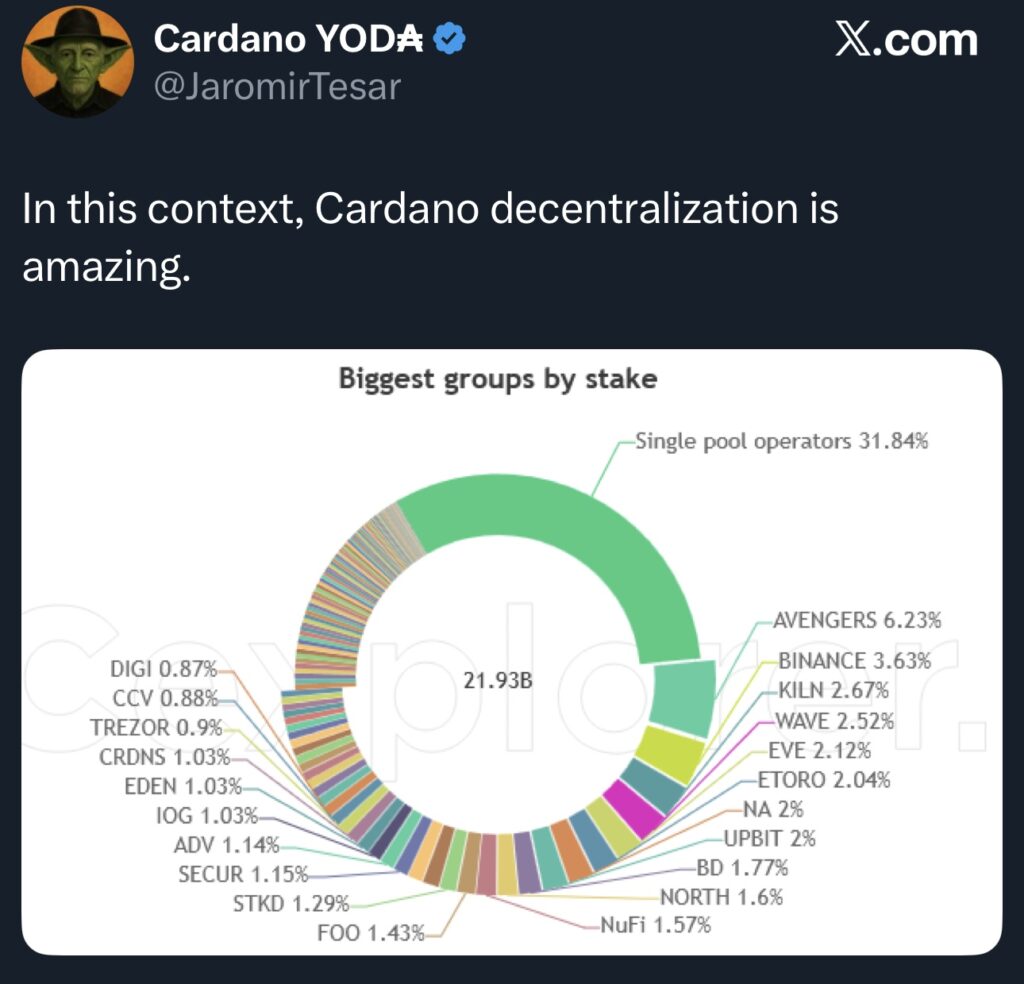
This is reflected in its Nakamoto Coefficient, a number that tells us how many independent entities are needed to shut down the network.
For Bitcoin, that number has dropped toward 4, currently 2. For Cardano, it’s well above 20.
Unlike Bitcoin mining, Cardano’s staking is not dependent on specialized machines. Anyone with a modest amount of ADA and a stable internet connection can run a node or delegate to small pools. That drastically lowers entry barriers and naturally spreads control.
One of the recent charts shows that Cardano’s delegation ratio has actually grown during the broader market dip, which means smaller holders continued to stake, showing belief in the system’s structure.
51% Attack on Bitcoin Now Costs Less Than Before
Bitcoin’s design relies on one key idea: it would be too expensive to attack. But that assumption is getting weaker.
The estimated cost of a 51% attack on Bitcoin has dropped, not just due to price volatility, but because of:
- More efficient ASIC miners
- Energy subsidies in some mining regions (e.g., Texas, China, Russia)
- Cheaper hosting services at scale
One chart shows that if a single entity controls Foundry and just one or two other pools, it could gain over 50% of the hashrate, enough to launch a reorganization or censor transactions.

This doesn’t mean such an attack will happen, but it’s now technically possible, which wasn’t the case a few years ago.
Even if just two large pools are coordinated (intentionally or by policy), they could dominate the network.

Cardano, by contrast, has no economic incentive or structure that allows such concentration. Attackers would need to convince dozens of pools and validators, each with different locations, jurisdictions, and community backing. It’s a harder target to centralize.
Bitcoin traded around $113,000, but the Bitcoin decentralization narrative is showing real cracks. Three pools control most of the network.
Foundry USA’s dominance is rising fast, while older pools are fading. The cost to attack the chain is dropping, and the network’s geographic concentration is at its highest in years.
The post Bitcoin Decentralization Under Pressure: Is Cardano Better Positioned? appeared first on The Coin Republic.